

When Syazmee Sapian & Associates (SSA) engaged us in April 2026, the firm was facing a challenge many businesses encounter when running digital advertising:
They were spending money on marketing, but lacked clear visibility into :
- who their leads were,
- what those leads actually wanted,
- how much it truly cost to acquire a paying client,
- and whether the Google Ads campaigns were genuinely profitable on their own.
This lack of clarity made decision-making difficult.
Without proper data separation, results from Google Ads could easily become conflated with enquiries coming from other channels such as TikTok organic content, referrals, and word-of-mouth.
As a result, it became difficult to confidently evaluate:
- actual ad performance,
- true customer acquisition cost,
- and the real profitability of the advertising campaigns.
Before scaling further, the business first needed better visibility.
Moving Beyond “More Leads”
Rather than immediately focusing on increasing ad spend, we focused first on improving the quality of the data being collected throughout the funnel.
To achieve this, we implemented an interactive multi-step inquiry form that asked visitors what they were actually looking for before submitting an enquiry.
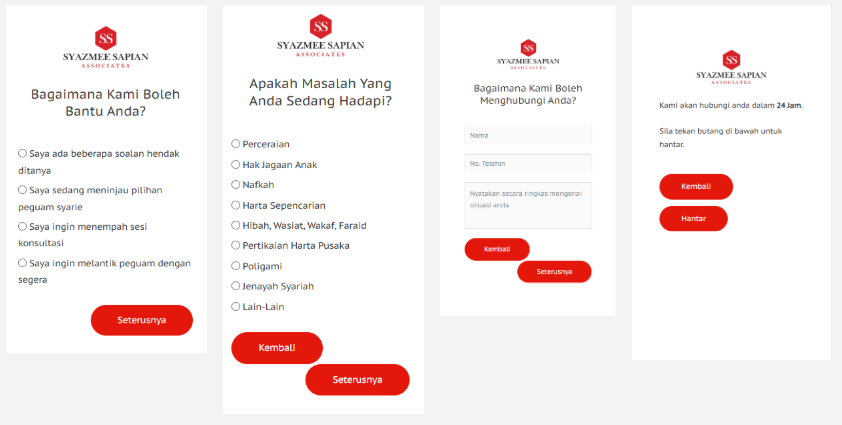
Some of the key questions included:
- whether they simply had a few questions to ask,
- whether they were still considering their options,
- or whether they were ready to book a consultation immediately.
The form also asked prospects what type of legal issue they were facing, such as divorce, child custody, nafkah, inheritance disputes, or syariah-related matters.
This allowed the business to uncover something extremely valuable: the intent behind each lead.
Discovering the Real Audience Behaviour
Once the new system was implemented and enough data was collected, a very important insight emerged during discussions with the client.
The majority of users entering the funnel were selecting:
“Saya ada beberapa soalan hendak ditanya”
(“I have a few questions to ask”)
instead of:
“Saya ingin menempah konsultasi”
(“I want to book a consultation”)
At first glance, both may appear to be “leads.”
But the data revealed something much deeper.
After analyzing the enquiries further with the client, we discovered that approximately 91% of users who selected “I have a few questions to ask” did not progress into actual consultations.
On the other hand, around 50% of users who selected “I want to book a consultation” successfully progressed into consultations.
This completely changed the understanding of the funnel.
Before the interactive booking form existed, all enquiries were grouped together under a single “lead” category. The business could see the number of form submissions, but had no visibility into the intent or quality behind those leads.
The interactive funnel changed that.
It revealed:
- which leads were genuinely high-intent,
- which users were primarily looking for free advice or general information,
- and which type of audience was actually contributing to revenue-generating consultations.
This insight became extremely valuable because it showed that the problem was not necessarily the number of leads, but the composition of those leads.
And because the business could now identify the behavioural patterns behind different enquiries, the next optimisation step became clear: refine the advertising and messaging strategy to attract more consultation-intent users while filtering out lower-intent traffic seeking free advice.
Understanding True Marketing Profitability
Another major advantage of the improved tracking system was the ability to calculate more realistic acquisition and profitability data.
SSA used to direct the leads to WhatsApp, which makes differentiating between which source (Google Ads, TikTok, or referrals?) very difficult and tricky. With the multi-step form, SSA could now better understand:
- the confirmed leads that are from Google Ads,
- actual cost per acquired customer,
- consultation-to-close rates,
- and the profitability of Google Ads campaigns independently.
This prevented the business from mistakenly attributing results from referrals, repeat customers, or TikTok organic traffic to paid advertising campaigns.
For growing businesses, this distinction is critical.
Further campaign developments and results will be updated as optimisation continues.